Selected design
Transformer design
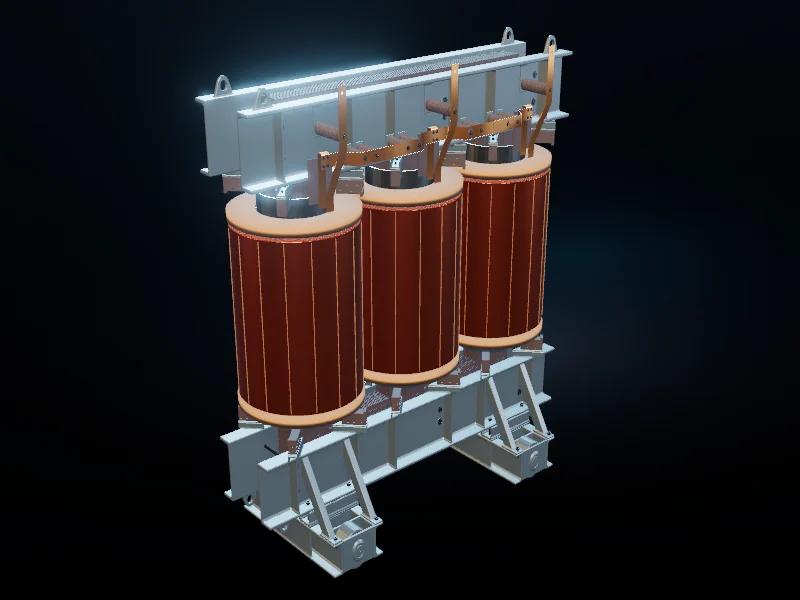
Loading interactive model

Teaching a language model to design power transformers.
A reinforcement-learning environment where the reward is physics. Kimi K2.6 produces compliant, solver-checked designs on 74% of unseen specifications, up from 43%.
Power transformers gate new electrical capacity, yet large units can take more than two years to arrive. Design alone still requires weeks of expert iteration across electromagnetic, thermal, dielectric, and mechanical constraints.
IronBench turns that loop into reinforcement learning with verifiable rewards. A policy emits geometry and materials; a deterministic physics oracle derives performance and rejects any hard violation. Trained on Kimi K2.6, it reaches 74.4% compliance on 900 unopened specifications (up from 42.7%) and 93.0% pass@4. These are frozen-simulation results, not factory-tested hardware.1
01The environment
Transformer design fits RLVR: outputs are structured, core checks are deterministic and cheap, and acceptance tests define measurable targets.
Machine-checkable output. The policy emits only construction primitives for the core, windings, insulation, and tank as a fixed JSON artifact.
Fast physics. Millisecond models score ratio, flux, losses, impedance, clearances, temperature rise, and short-circuit limits.
Groundable reward. IEEE and IEC tests measure the same observables, so each factory test can calibrate the next verifier.2
Rating, voltages, vector group, limits, and cost rates.
Geometry and materials only. No self-reported performance.
Performance, consistency, and validity-domain checks.
Pass every hard check, then earn a bounded cost bonus.
Reward is zero unless every hard check passes. Compliant designs are scored by total ownership cost (TOC): costlier designs earn less than 1, while cheaper designs earn a capped bonus above 1.
reward = 0                                             any hard check fails
reward = TOC_base / TOC                                compliant, costlier than baseline
reward = 1 + min(cap, gain · (TOC_base / TOC − 1))       compliant, at or below baseline cost
Each procedural task includes a hidden feasible witness and cost baseline. The policy sees neither.
02Anatomy of a design
The policy chose about forty construction fields for this 2.5 MVA unit; the verifier computed every performance value.
CoreFlux
Grade, limb diameter, and turns set peak flux and no-load loss. The overlay slows the 60 Hz field by 240×.
WindingsLeakage
Opposing ampere-turns drive leakage flux through the LV–HV channel, making the gap the main impedance lever.
ThermalRises
A two-node ONAN model converts losses into top-oil and winding rises; detailed CFD remains an audit.
03Training
We train Kimi K2.6 using reinforcement learning with verifiable rewards (RLVR). Bounded verifier calls guide design revision within each rollout; final rewards drive batch policy-gradient updates to a rank-32 LoRA adapter. The compiler and verifier remain fixed, and evaluation freezes the policy weights.
The compiler parameterizes a design with four continuous, three integer, and two categorical variables. Geometry is derived deterministically; performance is computed by the verifier.
| Type | Variable | Admissible domain | Role in the design |
|---|---|---|---|
| Continuous (4) | b_target_t | [0.65, 1.80] T | Target core flux density; determines core area. |
vpt_factor | [0.25, 0.65] | Scales volts per turn, setting winding turn counts. | |
j_target_a_mm2 | [1.0, 4.0] A/mm² | Target current density; determines conductor area. | |
extra_gap_mm | [0, 30] mm | Extra LV–HV spacing; tunes leakage impedance. | |
| Integer (3) | lv_layers | {1, …, 32} | Low-voltage layer count; sets winding height and thickness. |
hv_layers | {1, …, 64} | High-voltage layer count; sets winding height and thickness. | |
ducts | {0, …, 4} | Ducts per winding; adds cooling surface and radial space. | |
| Categorical (2) | grade | {M3, M4, M5, M6} | Core steel grade; sets loss characteristics and cost. |
margin_profile | {standard, robust} | Selects construction clearances and thermal headroom. |
All intervals include both endpoints. Scroll horizontally to read all columns.
Verified trajectories initialized RL. The revised run preregistered selection, corrected misleading local recommendations, and penalized exact-repeat loops; a repair SFT was tested and rejected.
Four B200s served about 145 tokens/s for one request and 1,000 aggregate tokens/s at concurrency eight. Speculative decoding only helped at concurrency one, so training used target-only concurrent batches.3
04Results
Over 50 policy-gradient updates, the policy uses verifier feedback to improve hard-constraint compliance. Each update samples 256 design rollouts.
50 updates · 12,800 rollouts
Held-out evaluation. After at most three preregistered looks at a separate 600-task development set, the frozen policy reached 74.4% compliance on 900 unopened tasks. One secondary reward check narrowly missed its threshold; the frozen flag remains false.4
05The designs
These exact policy outputs span 1.5–2.5 MVA, 12.47–34.5 kV, and low-to-high impedance. Select a model to explore its construction, fields, and verification results.
Selected design
06Conclusion
IronBench demonstrates that reinforcement learning with verifiable rewards can improve transformer design within a defined simulation environment. This is a promising step toward engineering systems that learn to meet new specifications through explicit, testable feedback.
Modular design for remanufacturing is a natural next direction: retaining measured donor cores and tanks while optimizing replacement windings, insulation, and cooling for new requirements. Extending the action space to include module interfaces and reuse constraints could make component replacement and reconfiguration explicit design objectives.
A further direction is the search for optimal solid-state transformer designs, jointly considering converter architecture, magnetics, and control under efficiency, size, cost, and reliability constraints. This would require a new design space and verifiers for power electronics, protection, and device losses. Across both directions, detailed simulation and physical validation would be essential to turn promising candidates into deployable hardware.